
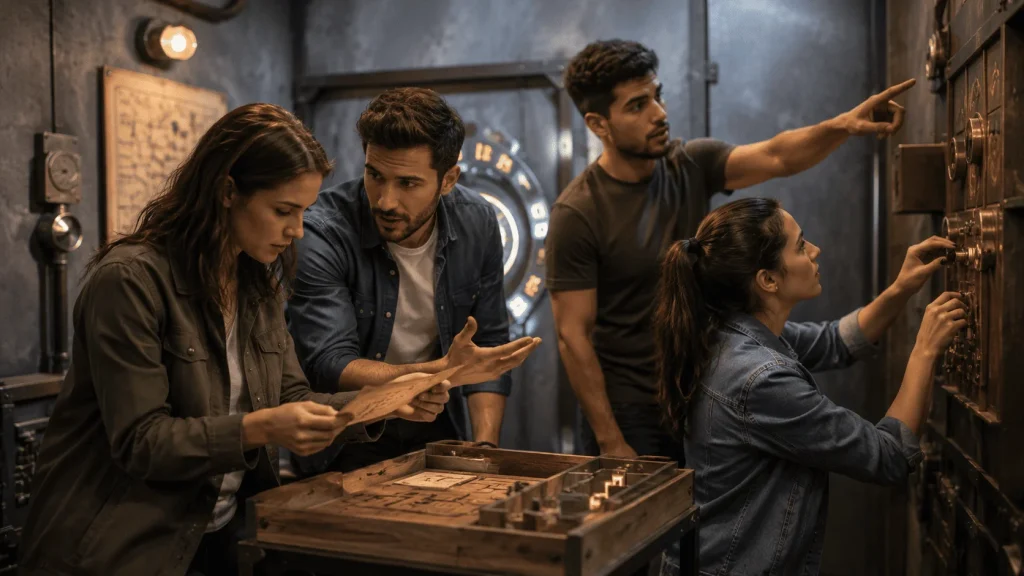
An escape room is not just a leisure activity where you have to solve puzzles before time runs out. When well-designed, it's a testing environment where people must observe, communicate, make decisions, adapt, and collaborate while working with incomplete information.
Among the main benefits of an escape room are the training of problem-solving, communication, critical thinking, time management, creativity, and teamwork.
What's interesting is that these abilities are not used in isolation: they appear simultaneously, just as happens when facing a professional project, resolving an unexpected family issue, or making an important decision.
Furthermore, each participant often discovers something about their own behavior. Some people notice details that no one else has seen, others organize the group, connect ideas, remain calm, or precisely execute a physical task.
Therefore, the value of the experience lies not only in passing a test, but in verifying how we think and work when there is a shared goal.
Escape room benefits: skills that are trained through play
The expression escape room benefits It's often associated with mental agility or teamwork. However, a complete escape room experience involves many more skills.
| Ability | What happens during the game | Real-life application |
|---|---|---|
| Problem solving | The team analyzes a situation and tests different solutions. | Dealing with incidents, projects, or complex decisions |
| Communication | Participants share clues and instructions | Coordinate at work, in studies or with family |
| Critical thinking | Useful information is distinguished from irrelevant information. | Evaluate options and avoid hasty conclusions |
| Time management | We must prioritize testing and abandon unproductive approaches | Meeting deadlines and organizing tasks |
| Creativity | Hidden uses and connections are being sought | Finding alternatives to new problems |
| Leadership | Someone organizes, listens, and facilitates decisions | Coordinate teams without constantly imposing |
| Adaptability | The plan changes when a strategy doesn't work. | Reacting to changes and unforeseen events |
| Frustration tolerance | Failure is part of the process | Learn from your mistakes and try again. |
| Coordination | Some tests require synchronization and precision | Execute shared tasks efficiently |
These skills aren't automatically acquired by completing a game. The game creates a situation where they can be practiced, observed, and reinforced. The more varied the challenges and the greater the group's involvement, the richer the experience will be.
1. Problem solving with incomplete information
One of the first skills activated in an escape room is problem-solving. The team enters an unfamiliar situation, receives limited instructions, and must figure out which actions will allow them to progress.
The process usually includes several phases:
- Observe the surroundings.
- Identify patterns.
- Formulate a possible explanation.
- Test a solution.
- Analyze the result.
- Correct the approach when necessary.
This cycle closely resembles the one we use outside of the game. In real life, we rarely have all the information before taking action. A client doesn't always clearly explain their needs, a project can change mid-way, and a breakdown can have several possible causes.
Escape rooms force you to move forward without waiting for a perfect solution to appear. The team must make a reasonable decision, test if it works, and learn quickly from the result.
A study conducted with 81 teams participating in an escape room found a positive relationship between the group's cognitive motivation and their performance.
The study also noted that certain profiles focused on finding the best solution could improve performance through greater cooperation.
2. Critical thinking: not everything is a clue
In an escape room, there's relevant information, secondary elements, and potential misinterpretations. Therefore, simply finding objects or accumulating data isn't enough: you have to decide what deserves attention and what can be disregarded.
Critical thinking emerges when the team asks itself:
- What do we really know?
- What are we taking for granted?
- Is this clue related to the current challenge?
- Do we have evidence that our interpretation is correct?
- Is there a simpler explanation?
One of the most common mistakes is becoming enamored with a theory. The group finds a possible connection and starts interpreting everything else to prove it was right. Meanwhile, it may be overlooking a much more obvious solution.
Learning to question a hypothesis without turning the conversation into a personal argument is an especially valuable skill. It is useful when analyzing information, comparing proposals, detecting errors, and making group decisions.
Several educational studies have used escape rooms as environments for developing critical thinking and collaboration skills. Participants often perceive these skills as necessary for progress, although their development depends on the activity's design, the players' involvement, and subsequent reflection.
3. Observation and selective attention
Finding a clue doesn't always mean looking more, but looking better.
When a game begins, some teams search everything haphazardly. They open compartments, move objects, and communicate their findings without a common approach. Others organize the space, describe what they find, and relate each item to the available information.
The second strategy is usually more efficient because it combines observation and organization.
This skill has clear applications in everyday life. Detecting an odd detail in a report, remembering an important instruction, identifying a change in a colleague's behavior, or discovering an error before submitting an assignment all require selective attention.
An escape room also demonstrates that good observation isn't just about noticing small details. Sometimes, the group is so focused on searching for hidden codes that they miss an obvious instruction right in front of them. Knowing how to alternate between a general overview and a detailed analysis is part of the challenge.
4. Clear communication and active listening
In an escape room, the information is usually scattered. One person finds a number, another discovers a mechanism, and a third remembers seeing a related symbol.
If that data is not shared, the team works like several isolated individuals.
Communicating effectively within the game involves much more than just talking:
- Describe accurately what has been found.
- Notify us of the tests already performed.
- Listen to an idea before dismissing it.
- Ask for help when you get stuck on a task.
- Confirm that everyone has understood an instruction.
- Prevent multiple people from repeating the same job.
Time pressure brings certain habits to the surface. Some people over-explain and slow things down. Others assume everyone else has understood their idea. It can also happen that one voice dominates the conversation and reduces the participation of the rest.
Effective communication should be brief, clear, and action-oriented. Phrases like “I found a key” are less effective than “I found a small key next to the red panel; we haven’t used it yet.”.
Analysis of social interactions within escape rooms shows that the way teams converse evolves during the game and that there are differences between the interaction patterns of successful and unsuccessful groups.
The research also suggests that some communicative tension can be useful when it helps to question ideas and move forward, as long as it does not turn into destructive conflict.
5. Teamwork and division of roles
A good team doesn't need all its members to do the same thing. It needs their contributions to complement each other.
During an escape room, different roles usually appear:
- The person who explores and detects elements.
- The one who connects seemingly separate clues.
- The person who manipulates mechanisms with precision.
- Who controls time and priorities.
- The person who organizes the information.
- The one who keeps the group's energy going after a failed attempt.
These roles shouldn't be rigid. One person can organize the team for one test and follow another's instructions for the next. This rotation allows for better utilization of each participant's abilities.
One of the biggest learning experiences occurs when the group stops looking for "the smartest person" and starts asking who can contribute the most value at any given time.
In a show like Prison Island, this diversity takes on special importance because the challenges aren't limited to solving puzzles. Its cells combine mental agility, skill, coordination, physical ability, and cooperation. This allows individuals with different profiles to find opportunities to excel.
The activity is carried out in teams and the objective is to score points by overcoming as many challenges as possible during the contracted time.
6. Shared leadership and decision-making
Leadership in an escape room isn't about giving all the orders. In fact, a player who tries to control every move can become an obstacle.
Effective leadership emerges when someone:
- It helps to prioritize.
- She makes sure that all ideas are heard.
- It detects when a strategy has ceased to be productive.
- Delegate a test to the most appropriate person.
- Make a decision when the group is blocked.
- It keeps the target visible without generating more pressure.
In a game, several leaders can emerge. One person might coordinate a logic challenge, while another leads a precision test. This flexible leadership style is closer to the needs of many professional teams today, where responsibility shifts depending on the project phase and the required expertise.
It also allows us to identify an important difference between directing and facilitating. Directing is telling people what to do. Facilitating is creating the conditions for the team to find and implement a good solution.
7. Time management and prioritization
The clock introduces a constraint that transforms the way we think. It's no longer enough to find a solution: we have to decide how much time each possibility deserves.
Time management in an escape room requires answering very practical questions:
- Do we continue with this test or change to a different challenge?
- Are we close to solving it or just repeating attempts?
- Do we need to ask for a hint?
- Is there another task that can be done in parallel?
- Which action is most likely to generate progress?
One particularly useful skill is recognizing sunk costs. Having spent ten minutes on an idea doesn't mean we should spend another ten. If it's not working, temporarily abandoning that approach might be the smartest decision.
Something similar happens in real life. We might continue an unproductive meeting simply because it has already started, insist on using a tool that doesn't solve the problem, or invest more resources in a decision just because we've already invested a lot.
The formats in which you can choose between different challenges, change cells and try again later add a strategic layer.
The team not only solves tests: it must also decide where to invest its time to achieve the best overall result.
8. Creativity and lateral thinking
Many challenges are designed so that the first interpretation is not enough. An object may have a different function than usual, a message may need to be read in a different order, and a physical test may be solved through coordination rather than strength.
Creativity emerges when the team stops asking "what is normally done with this?" and starts asking "what could we do here?".
This doesn't mean trying random actions. Effective lateral thinking combines imagination and logic. It proposes a different alternative, but looks for clues that allow it to be tested.
Outside of the game, this ability proves useful when designing a service, resolving a conflict, adapting a process, or finding a solution with limited resources. Creativity isn't exclusive to artistic professions.
It is also used when reorganizing a schedule, explaining a difficult concept, or finding a different way to meet a need.
9. Adaptability and ability to change strategy
A plan may seem correct and still not work. At that point, the team has two options: persist without reviewing its assumptions or change its approach.
Escape rooms provide a rapid form of adaptation training:
- A strategy is being implemented.
- An immediate response is received.
- The ruling is interpreted.
- The action is modified.
- It is tested again.
The speed of the cycle allows for experimentation without significant consequences for errors. Failing a test doesn't mean losing a client, failing an exam, or ruining a project.
However, the emotional reaction may resemble: frustration, doubt, looking for someone to blame, or loss of concentration.
Therefore, learning isn't just about finding the right answer. It's also about observing what the team does when their answer is incorrect.
10. Frustration tolerance and emotion management
A seemingly simple cell can be difficult to solve over several attempts. In these situations, the group's ability to remain calm is put to the test.
Frustration can lead to different behaviors:
- Repeat the same action with more intensity.
- Everyone speaks at the same time.
- Blame the person who proposed an idea.
- Stop participating.
- Ignoring obvious information.
- Making hasty decisions.
Managing emotion doesn't mean eliminating it. It means recognizing that the block is affecting performance and taking action: pausing for a few seconds, summarizing what you've learned, changing tasks, or moving on to another challenge.
This skill has a direct transfer to any context where we do not completely control the outcome.
A mistake, a negative response, or an unexpected change cannot always be avoided. What we can work on is how we respond.
11. Physical coordination and precision
Not all escape rooms are based solely on locks, codes, and puzzles. Some formats incorporate balance, aim, timing, reaction speed, or object manipulation.
These tests add an important dimension: knowing what needs to be done does not necessarily mean being able to do it.
The group may have fully understood the mechanism, but need several attempts to coordinate movements, control force, or synchronize an action. This is where patience, nonverbal communication, and precision come into play.
In Prison Island, the challenges can test different characteristics, such as mental agility, physical ability, and teamwork.
In addition, cells can be repeated, allowing you to review your strategy and try to improve your execution and score.
Why an escape room is more like real life than it seems
Although the setting is fictional, the dynamics reproduce very recognizable situations:
- There is a goal that must be achieved.
- The information is incomplete or scattered.
- Resources and time are limited.
- People have different abilities.
- Some decisions need to be made quickly.
- Mistakes force a change in the plan.
- The result depends as much on the idea as on its execution.
The main difference is that the game offers a controlled environment. You can experiment, fail, and try again without taking significant risks.
This combination of challenge, immediate feedback, and active participation explains why escape rooms have also been used in educational and professional contexts.
Research conducted with students has found positive results related to motivation, learning climate, collaboration, and performance, although these effects depend on the design of the activity and should not be interpreted as an automatic guarantee.
Not all escape rooms develop the same skills
To understand the benefits of a escape room Its design needs to be analyzed. An experience based solely on numerical puzzles will primarily benefit those who enjoy logic. In contrast, a format with varied challenges allows for more balanced participation.
The elements that enrich learning are:
Variety of challenges
The combination of logical, physical, technical, visual, and collaborative tests prevents a single person from solving everything.
Real dependence between participants
Teamwork is most meaningful when the solution requires several people to share information or perform coordinated actions.
Possibility to test and correct
Receiving feedback allows you to understand if the strategy is working. Repetition turns mistakes into useful information.
Freedom to make decisions
When the team can choose which challenge to tackle, it must also manage priorities, resources, and time.
Balanced difficulty
A challenge that's too easy requires little coordination. One that's excessively difficult can lead to disengagement. The right balance requires effort without conveying that progress is impossible.
Observable result
Time, points, or completed tests allow you to assess performance and consider how to improve it.
How to turn the game into a useful learning experience
The experience can be much more valuable when the group takes a few minutes to discuss what happened. A formal session isn't necessary. Simply answering a few questions after the game is enough:
- What did we do especially well?
- Where did we waste the most time?
- Do we share all the important information?
- Which person contributed a skill we were unaware of?
- When should we have changed our strategy?
- Do we listen to minority ideas?
- How do we react after failing?
- What would we do differently in a second game?
This conversation helps transform a general feeling (“we coordinated well” or “we were a disaster”) into concrete learning.
In companies, it can reveal communication problems, excessive hierarchy, or difficulties in delegating. In families and groups of friends, it allows for the discovery of new abilities and a better understanding of how each person makes decisions.
Who benefits from this experience?
Company equipment
An escape room allows you to observe how roles are distributed, who shares information, how disagreements are resolved, and what happens under pressure.
It does not replace a professional assessment or a training program, but it can serve as a starting point to talk about collaboration, leadership and organization in a less abstract way.
Students and school groups
Challenges transform learning into an active experience. Participants must explain ideas, listen to their peers, connect facts, and persevere.
Prison Island offers activities for educational centers in which students participate in groups and must collaborate, discuss possible solutions and overcome different challenges.
Families
In a family activity, adults and children temporarily step out of their usual roles. A child might notice a clue the adults have missed, or a normally reserved person might take charge and organize the group.
The experience works especially well when adults help without taking over all the decisions.
Couples and groups of friends
Solving challenges together allows you to break out of your usual conversations and plans. It also tests your rapport, listening skills, and how you handle minor disagreements.
In Prison Island, some of the cells can be completed in pairs, although the overall format is designed to encourage collaboration in small teams.
Prison Island: More than just a conventional escape room
In a traditional escape room, the team usually follows a story within a single room and must complete a sequence of tests to reach a final goal.
Prison Island offers a different format. Teams move between different cells, each with its own unique challenge. During the session, they can choose which challenges to attempt, repeat them, and aim for the highest possible score.
This format introduces decisions that don't usually appear as strongly in a linear theater:
- Choosing which cell to tackle.
- Deciding when to temporarily abandon a challenge.
- Distribute tasks according to the type of test.
- Adapt quickly to very different challenges.
- Improve a strategy after a failed attempt.
- Balancing speed, accuracy, and score.
Currently, the experience features 26 cells and is designed for small teams competing for points during sessions of one, one and a half, or two hours. Some tests focus on mental skills, others incorporate physical ability or effort, and many require coordination among participants.
This means the activity doesn't just reward those who solve puzzles quickly. A good result depends on discovering the team's strengths and using them at the right time.
So, does an escape room really improve these skills?
An escape room doesn't automatically make a person a better communicator, leader, or strategist. What it does is create an intense and engaging situation where those skills are necessary.
The true value emerges when combining three elements:
- Practice: The player uses the skill during the challenge.
- Feedback: Check immediately if your performance is working.
- Reflection: Identify what you could keep or change.
A single game can help uncover behaviors. Improvement comes when that discovery is then applied in other contexts.
Therefore, rather than stating that an escape room "teaches teamwork," it is more accurate to say that it allows you to practice, observe, and analyze teamwork in action.
Frequently asked questions about the benefits of an escape room
What skills are needed to do an escape room?
There isn't one single essential skill. Logic helps, but observation, communication, creativity, coordination, and the ability to remain calm are also important. The best teams are usually those that combine different skill sets.
Does an escape room improve intelligence?
There is no evidence to suggest that playing a game generally increases intelligence. However, it can enhance processes such as attention, working memory, reasoning, cognitive flexibility, and problem-solving.
Do escape rooms help promote teamwork?
Yes, provided the tests require genuine collaboration. Sharing information, distributing tasks, coordinating actions, and making joint decisions allows you to observe how the group functions and identify opportunities for improvement.
Are they useful for a corporate event?
They can be a useful activity of team building because they take participants out of their usual environment and present them with shared objectives. Their value increases when a brief reflection is carried out afterward on the communication, roles, and decisions made.
What do children learn in an escape room?
They can practice observation, reasoning, communication, patience, and cooperation. The activity should be adapted to their age and include adult supervision when required by the center's regulations.
Do you have to be in good physical shape?
It depends on the type of experience. Many escape rooms focus primarily on puzzles and observation. Others, like Prison Island, include a variety of mental, technical, and physical challenges. Not everyone has to excel at every puzzle; the goal is to combine the team's abilities.
What happens if we fail to solve a test?
Failing a challenge is also part of the experience. It allows you to analyze which strategy didn't work, reorganize the team, and decide whether to repeat the attempt or change challenges.
Much more than finding the exit
The benefits of an escape room don't depend solely on the number of puzzles solved. They also lie in the conversations, decisions, failed attempts, and changes in strategy that occur during the game.
Problem-solving, clear communication, listening, delegating, time management, and staying calm are necessary skills inside an escape room, but also outside of it.
In an experience with varied challenges, each participant can discover a different way to contribute. Some people lead, others observe, connect ideas, execute precise movements, or help the team refocus after a mistake.
Ultimately, the most interesting question isn't just how many tests the group has passed. It's what they've learned about how they think, collaborate, and react when time is running out.