
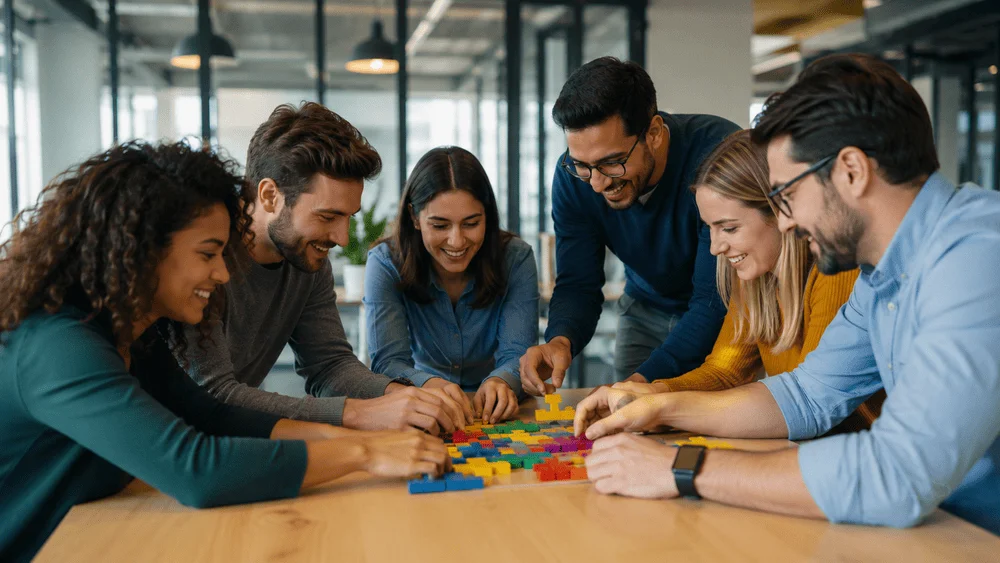
Teamwork is one of the fundamental pillars for the success of any company. When people collaborate effectively, communication improves, projects progress more smoothly, and the work environment becomes more positive.
However, building cohesive teams doesn't happen by chance: It requires time, shared experiences, and activities that help strengthen relationships between colleagues.
One of the most effective ways to achieve this is through games and activities. team buildingThese activities allow employees to break out of their usual routine, develop new skills, and learn to collaborate in contexts different from their daily work.
Below, we present 15 games to promote teamwork in companies, ideal for improving communication, trust, and cooperation among members of any organization.
Why are teamwork games important?
Before getting into the specific dynamics, it is worth understanding why these activities have such a significant impact on businesses.
Collaborative games help to:
- Improve communication between departments and colleagues.
- Strengthen mutual trust.
- Identify hidden skills and talents.
- To enhance leadership and decision-making.
- Reduce tension and improve the work environment.
- Promote the integration of new employees.
- Increase motivation and commitment.
Furthermore, they allow us to observe how people interact outside of formal settings, which is very useful for identifying opportunities for improvement in team dynamics.
Prison Island: Collaborative Team Challenges
Prison Island is an activity that combines strategy, physical skill, logic, and cooperation. Participants form teams and must overcome different challenges distributed across multiple themed rooms.
Each challenge requires different skills, so every team member has the opportunity to contribute. Some tests demand mental agility, others physical coordination, and still others excellent communication.
Benefits
- It fosters genuine collaboration.
- It enhances problem-solving skills.
- It strengthens trust between colleagues.
- It promotes shared leadership.
It is a particularly interesting option for companies looking for a different and memorable team building experience.
The assembly line challenge
This game works very well in companies because it reproduces a very common situation in any team: one person's work directly affects the result of the rest.
To organize it, the group is divided into teams and given a task in phases, such as assembling a simple structure, ordering a sequence of steps, preparing a fictitious product, or solving a process with several connected parts.
Each participant is responsible for a specific phase, and the team can only move forward if everyone fully understands what they have to do and how their part influences the next one.

This requires coordination, clear communication of instructions, and attention to the work of others, not just one's own.
What's interesting about this dynamic is that it often brings to light very common problems in the workplace: unclear instructions, duplicated tasks, lack of communication between departments, unnecessary waiting, or people who don't have a complete view of the process.
That's why it's an especially useful activity for teams that work by departments, projects, or shared workflows.
What works
- Coordination.
- Internal communication.
- Shared responsibility.
- Global view of the work.
- Process improvement.
Practical tip
Conduct a first round with basic instructions and a second round after the team suggests improvements. Comparing both results helps to clearly see how better organization can completely change the group's performance.
Blind construction
In this dynamic, one person describes a structure while the rest try to build it without seeing it.
It can be made with blocks, building pieces, or even office supplies.
What develops
- Active listening.
- Clarity in communication.
- Patience.
- Interpretation skills.
It is a simple but very revealing activity about how information is transmitted within a team.
The Marshmallow Challenge
This famous exercise consists of building the tallest possible tower using spaghetti, tape, string, and a marshmallow that must be placed on top.
What does it contribute?
- Creativity.
- Innovation.
- Collaborative work.
- Error management.
Teams quickly learn that testing and adjusting is often more effective than planning for too long.
Treasure hunt
The classic treasure hunt can be perfectly adapted to the business environment.
Teams must solve clues and complete challenges to advance to the final goal.
Benefits
- It promotes cooperation.
- Improve communication.
- It increases motivation.
- It promotes joint decision-making.
It can be set up both indoors and outdoors.
Laser Tag by teams
Laser tag is much more than a recreational activity. When approached with strategic objectives, it becomes an excellent team-building tool.
Teams must coordinate movements, establish tactics, and communicate constantly.
Skills developed
- Leadership.
- Strategy.
- Coordination.
- Trust.
In addition, it creates a fun experience that strengthens the bonds between colleagues.
Wordless communication
In this activity, participants must complete a task without using verbal language.
They can only communicate through gestures, facial expressions, or movements.
What work is done
- Nonverbal communication.
- Observation.
- Empathy.
- Coordination.
Teams often discover new ways to collaborate when they eliminate words.
The paper tower
Each group receives sheets of paper and adhesive tape to build the tallest structure possible.
Although it seems simple, challenges related to planning and organization quickly arise.
Benefits
- Creativity.
- Resource management.
- Collaborative work.
- Problem solving.
It's ideal for large groups and small budgets.
Role-playing of work situations
The participants represent scenarios related to clients, internal conflicts, or business situations.
What develops
- Empathy.
- Communication.
- Emotional management.
- Conflict resolution.
It allows you to practice important skills in a safe and controlled environment.
Chain of decisions
A fictitious business problem is presented, and the team must make successive decisions as new data emerges.
Skills worked on
- Strategic thinking.
- Adaptability.
- Decision making.
- Uncertainty management.
It is especially useful for management teams or middle management.
Map of fortresses
Each participant identifies their own strengths and those of their peers.
A visual map is then created that shows the team's capabilities.
Benefits
- Mutual recognition.
- Trust.
- Self-knowledge.
- Group cohesion.
It helps to value internal talent and improve collaboration.
Debate with role reversal
Participants defend a specific position and, halfway through the exercise, must argue the opposing position.
What does it contribute?
- Active listening.
- Empathy.
- Critical thinking.
- Mental flexibility.
It's an excellent dynamic for understanding different perspectives within the organization.
Mission Impossible
The teams receive a series of challenges that they must complete within a limited time.
The tests may combine creativity, logic, physical skill, and teamwork.
Benefits
- Time management.
- Organization.
- Cooperation.
- Motivation.
The variety of challenges allows everyone to find a way to contribute.
The bridge between departments
This activity seeks to improve collaboration between areas that normally work independently.
Participants identify needs, obstacles, and opportunities for improvement across departments.
What develops
- Cross-cutting communication.
- Mutual understanding.
- Conflict resolution.
- Internal collaboration.
It is especially useful in growing companies.
Gamified retrospective
Through letters or dynamic questions, the team reflects on recent projects, identifies lessons learned, and proposes improvements.
Benefits
- Constructive feedback.
- Continuous improvement.
- Transparency.
- Trust.
Transform a traditional meeting into a much more participatory experience.
How to choose the right activity
Not all games are suitable for all teams. Before organizing a team-building activity, it's important to clearly define the objective.
If you are looking to improve communication
- Blind construction.
- Escape Room.
- Wordless communication.
If you want to strengthen trust
- Prison Island.
- Map of fortresses.
- Gamified retrospective.
If the goal is to enhance leadership
- Laser Tag.
- Chain of decisions.
- Mission impossible.
To integrate new employees
- Treasure hunt.
- Paper tower.
- Prison Island.
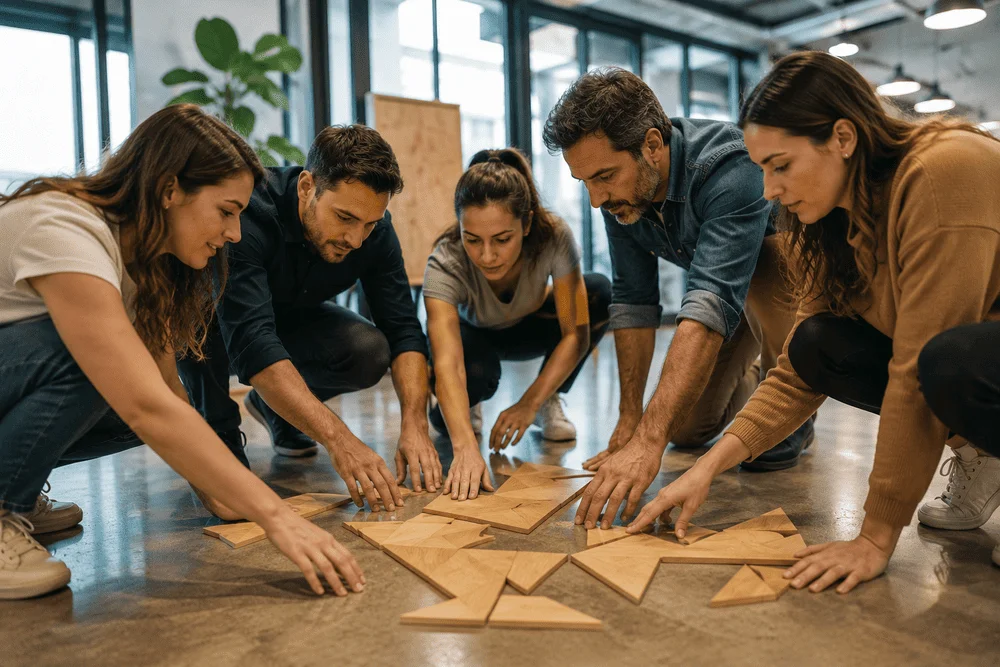
Choosing the right activity significantly increases the impact of the experience.
Common mistakes when organizing team building activities
Many companies invest time and resources in activities that ultimately do not generate results because they make some common mistakes:
- Not defining clear objectives.
- Choosing activities that are not very inclusive.
- Forcing participation without generating motivation.
- Not to engage in further reflection.
- Organizing events that are too long or complex.
The key is to find a balance between fun, participation, and learning.
Conclusion
Team-building games are much more than just a recreational activity. When well-designed, they improve communication, strengthen relationships, develop skills, and create more cohesive teams.
From simple office activities to immersive experiences like Prison Island, there are options for all types of businesses and objectives.
The important thing is to choose activities that allow people to collaborate naturally, discover new skills, and share positive experiences that they can then transfer to their daily work.
When a team learns to overcome challenges together, it also learns to work better together.